J Blanch & Son. 29
Gracechurch Street, London
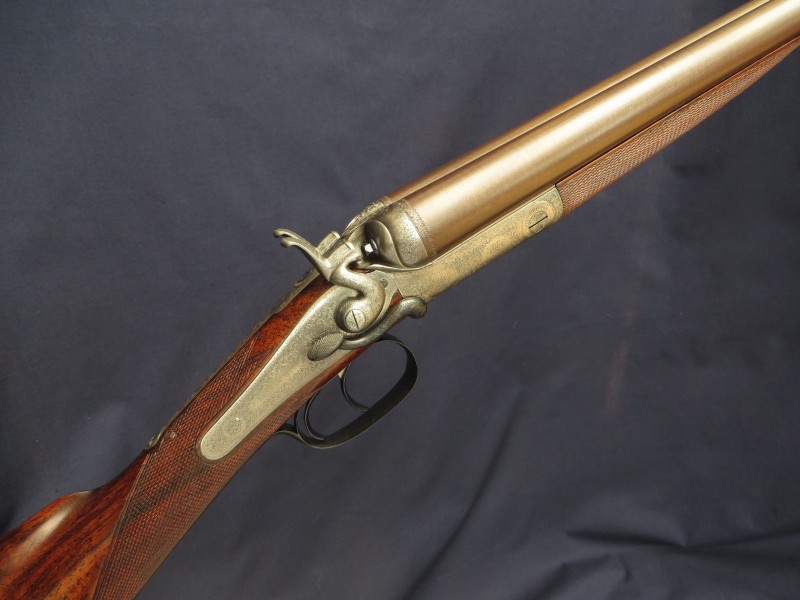
12 bore Side lever, Back-action Hammergun
no. 5354
Date of manufacture: circa 1883
 |
 |
 |
 |
||
 |
 |
 |
|||
 |
 |
||||
Click on these images for more detail.
|
Heritage
Guns' Comment
This lovely hammergun, made by one of London’s smaller but highly
respected gunmakers, is in amazing condition for its age: not only
are the internals in fine condition but also the prolific
engraving is crisp and clear. Unusually for Blanch, whose records
were destroyed by German bombs in 1942, we can date this gun quite
accurately to 1883 as a Blanch gun only a few numbers separated
from 5354 shared a numbered patent mark with a Holland & Holland
gun that is dated in their records. Until the late 1890’s Blanch
used the sidelever and back-action locks as their preferred
mechanisms on nearly all their ‘in-house’ guns, the more
ubiquitous toplever and bar-action locks being relegated to their
‘bought-in’ guns, often of lesser quality. Some rotary underlevers
and occasional thumblever will be seen but the sidelever is the
norm for guns made ‘in-house’. The full coverage of Bouquet &
Scroll engraving is also very much the house style for this period
and is beautifully executed. This is a most attractive gun with
its classic London engraving style and, given its fine balance,
highly figured stock and stylish sidelever, it would make an
excellent gun for upland game or clays.
|
The action
is of traditional design and features:
Double triggers;
Finely
sculpted ‘Percussion’ fences; Low level, facetted hammers;
Rebounding back-action locks by John Moore;
Sidelever operating a
double bite ‘Purdey Bolt’;
Modified Hollis forend lever catch:
Extended top tang.
Additional triggerguard screw fitted.
Gun weight 6lb 11oz
Engraving style Best
Bouquet & Scroll.
Forend lever engraved ‘J BLANCH & SON’S IMPROVED
SNAP BOLT’.
Triggerguard, forend iron and barrels all marked with
serial no. 5354.
Trigger pulls measure approximately: Front
trigger 3 ¾ lbs Rear trigger 4 ¼ lbs.
The original damascus barrels
are 28" in length, chambered for 2 ½” (65mm) cartridges
and are of
brazed 'dovetail' lump construction with soft soldered ribs.
Top rib
is of the ‘swamped’ type with a raised ‘shield’ between the fences.
There are a few small vestigial pits.
Birmingham reproof
for 65mm nitro powder cartridges in 1994.
Approximate barrel measurements at date of publication:
|
Nominal Proof Size
|
Bore Diameter 9"
from Breech |
Minimum Wall Thickness
|
Choke Constriction
|
|
|
|
18.7mm (0.736") |
0.738"
|
0.027"
|
0.002"
(Sk)
|
Left Barrel |
18.7mm (0.736") |
0.738"
|
0.027"
|
0.032"
(IM/F)
|
The Straight Hand Stock (possible vintage replacement) and original Splinter Forend are crafted from highly figured walnut. The stock has neutral cast, features a vacant white metal oval fitted to the rear comb of the stock and a 1” leather covered recoil pad. The forend features Blanch’s usual lever forend catch and has a small inlet repair to its edge. The gun balance 3/8" behind hinge centre.
 |
Highly Figured Walnut
|
 |
The 20 lines per inch chequering
has been
freshened to their original pattern.
The stock is finished with a traditional linseed oil based preparation
as used on best guns by one of the top English makers. This finish
uses no grain fillers to achieve its deep, smooth lustre, only many
hours of alternate build and flatting off of the surface.
Approximate stock measurements at date of publication:
|
Pull to Heel
|
Pull to Bump
|
Pull to Centre
|
Pull to Toe
|
|
14 1/2"
|
14 3/4"
|
14 5/8"
|
15 1/8"
|
|
Drop at Comb
|
Drop at Face
|
Drop at Heel
|
|
1 1/2"
|
1 3/4"
|
2 1/4"
|
|
Cast at Comb
|
Cast at Heel
|
|
Negligible
|
Negligible
|
For the purposes of these measurements,
'Drop at Face' is the 'drop' measurement taken on a line perpendicular
to the
line joining the trigger and centre of the butt at approximately 8"
from the trigger (front trigger on a double trigger gun).
Patents Exhibited include:
'Purdey Bolt' patent no. 1104
of 1863;
Stanton's rebounding lock patent no. 367 of 1867;
Hollis’s forend catch patent no 953 of 1873.